

Memorandum
The Memorandum will be available soon.
Reception at the nursery school building, located along Rue Richard Coudenhove-Kalergi, will take place:
_ for pupils who attended the first year of nursery school during the 2026-2027 school year on Wednesday, 2 September 2026 at 8:30 and
_ for new pupils on a rotating basis and in small groups from 3 September 2026, in order to ensure a smoother integration of “beginners” with all the attention they need on their first day of school.
All parents of new pupils should have received an enrolment date for 19 July 2026. If this is not the case, please contact our school office (tel. 43 20 82-270) from 26 August 2026 onwards.
Parents will be allowed to accompany their children to the classroom during the first two weeks of school (2 to 16 September). After that, children will be welcomed by teachers and assistants in the entrance hall and parents will no longer be allowed to enter the building without justification (see point 20 Internal Regulations below).
Cleanliness in nursery school
Children must be independent in using the toilet before starting preschool. The educational team does not accept children who are still wearing diapers.
All primary school classes are located in the primary school building along Boulevard Konrad Adenauer and Rue Léon Hengen. The entrance is via the “bus” gate located along the bus stop on Rue Léon Hengen.
The start of the school year is set for Wednesday, 2 September 2026 (see detailed planning below).
To make the beginning easier for the 1st year pupils, their arrival has been fixed 30 minutes after that of the other pupils, so at 9:00.
The meeting point in the primary school playground for each language section will be indicated by a sign with the respective initials of each section (DE-EN-ES-FI-FR-LT-NL-PL-PT-SV).
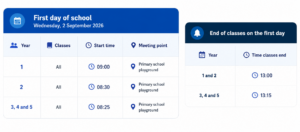
First day of school (02.09.2026):
_ P1: parents may accompany their children to class from 9:00 to 9:30
_ P2+P3+P4+P5: parents may accompany their children to class from 8:30 to 9:00
Second day of school (03.09.2026):
_ P1+P2: Parents may accompany their children to class from 8:30 to 9:00.
_ P3+P4+P5: Parents are welcome in the school playground but may not accompany their children to class.
After 4 September 2026: Parents will only be allowed to enter the school premises if they have an appointment with a member of the school staff.
During these two days, parents may enter and leave the site using the gate located at the bus stops.
Please note that parents or guardians will not be allowed to enter the classrooms without being accompanied by the class teachers. For this reason, you will find the teachers in the school playground in the morning, holding a sign. From there, the teachers will then go to the classrooms.
_ All pupils will return to school on Wednesday, 2 September 2026 at 8.15.
_ First-year secondary school pupils will be welcomed at 8:15 in the secondary school playground under the covered area of Building B, next to the cafeteria (on the side of the Salle des Fêtes).
_ Parents of Year 1 pupils may enter the playground to accompany their children on this first day of school (max. 2 accompanying adults).
_ Pupils will be called by their form teachers and the first-year educational advisor, who will direct them to their respective classrooms.
_ Exceptionally, entry will be via the gate located between the administration building and the Salle des Fêtes. A text message will be sent at the end of August, which must be presented to the security guards in order to access the playground.
_ As soon as the teachers take the pupils to their classrooms, we ask parents/accompanying adults to leave the premises immediately. Parents/accompanying adults are not allowed to accompany pupils to their classrooms.
The school certificate will be sent electronically to all parents by the end of September and may be used for any purpose.
In accordance with the law of 20 July 2023 on compulsory education, the school must transmit required data — including the national identification number (matricule) of pupils residing in Luxembourg — to the Ministry of National Education to monitor school attendance.
From September 2026 onwards, no certificate will be issued for resident pupils whose matricule has not been provided.
The information must be submitted as soon as possible, and at the latest the day before the pupil starts school.
Pupils are collected by the educators of the childcare center on Mondays between 15.30 and 15.40 and from Tuesday to Friday between 12.30 and 12.40.
Parents can pick up their children on Mondays between 15:40 and 16:00 and from Tuesday to Friday between 12:40 and 12:50.
For parents who need to bring their children earlier to school, a supervision is organised at the school from 8:00 to 8:15 in a room in the Nursery school building.
When parents drop off or pick up their children at the nursery school, they must present a badge or an ID card at the entrance.
There is no supervision after school. In the event of a late arrival, parents must collect their child from room B903 at the primary school. The terms and conditions for charging for late pick-ups are identical to those for late pick-ups at the primary school. Please refer to our attached “Uncollected Child Policy” [Appendix 2].
Lessons for children in P1 and P2 end at 15:30 on Mondays and Wednesdays, or at 16:00 if the child participates in the “Well-being at School” programme. [Well-being at School – OPTIONAL].
Please note that lessons for P3, P4 and P5 start at 8:25: access to the playground is open at 8:10.
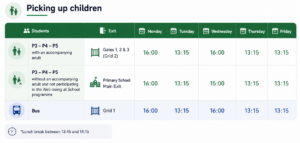
We ask parents to fully respect the school timetable: children should be brought to and collected from school at the official times. Arriving late results in missing a part of the lesson and disrupting the other pupils and the teacher. In addition, some activities take place in other rooms (Physical Education, swimming, music, library, etc.) and latecomers find themselves alone in front of the classroom.
In the event of late arrival (once the bus gate has closed), parents must accompany their child to the guard at the main entrance of the primary school.
At the end of the school day, it is essential that pupils are collected as soon as lessons finish. At the primary school, teachers supervise the exit from classes but are not required to supervise pupils who have not been collected.
However, if a parent is late the school takes care of the child and contacts them after 15 minutes. The supervisor is responsible to wait 15 minutes at grid 1 (bus gate) of the primary school from 13.15 (Tuesday, Thursday and Friday) and from 16.00 (Monday and Wednesday). After this time, the supervisor takes the child to room B 903 (IT room in the primary building) to call the parents. The parents, legal guardian or authorized person retrieves the child after signing a discharge form. If no parents or guardian can be reached, the school reserves the right to charge 35 € for each additional hour of work started. The parents will receive an invoice from the school’s accounting department.
Please note that each delay in collecting a pupil is noted in his/her file. For further information, please refer to our Uncollected Child Policy [Appendix 2].
Free afternoons – Secondary school
Some pupils may be required to be present at school on their official free afternoons, for example those attending catch-up classes (rattrapage), Learning Support, certain classes of Religion and Ethics,
mother tongue (L1) for pupils without a language section (SWALS), and pupils following Other National Languages (ONL) courses such as Irish, Maltese, Finnish or Swedish.
First-year pupils are normally free on Tuesday and Thursday afternoons.
Second-year pupils are normally free on Thursday afternoons.
Year 3 pupils are normally free on Friday afternoons.
Year 4 pupils are normally free on Friday afternoons.
Year 5 pupils are normally free on Wednesday afternoons * .
There is no guaranteed free afternoon in Years 6 and 7.
Students who have a free afternoon may remain on campus during Period 6 for lunch. However, they must leave the school premises by 13 :15 h.
Please note that the school does not provide supervision for students during free afternoons. Parents are therefore responsible for arranging appropriate care and supervision after their child has left the school premises.
* For these pupils, a bus will depart at 13:30 from Grid1 at the Centre-Gare station.
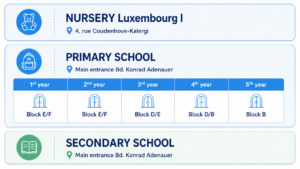
All pupils will be located on the Kirchberg Plateau site, as follows:
SECURITY LEVEL – YELLOW
The European School Luxembourg I’s security alert state is currently fixed at YELLOW level. Special measures have been implemented in order to guarantee the security of the school.
_ All secondary pupils must present their pupil card to security guards to access the premises.
_ Visits are authorized only upon appointment.
_ When you visit us, we ask you to follow the instructions of the security guards.
_ The security guards are allowed to control the contents of bags.
_ Visitors are not allowed to access the site with packages.
Our school promotes sustainable transport and encourages pupils to walk, cycle or use public transport (tram, bus) to get to school.
Please note that traffic around the school is very heavy. Therefore, young pupils must be dropped off and picked up at the nursery building by their legal representatives or an authorised person. [under the conditions set out in the section -Timetable/nursery school].
🔗Directions + Public Transport
By school transport with the Association des Transports Scolaires des Elèves des European Schools (ATSEEE):
ATSEEE: 🔗Shuttle Busses + 🔗Timetables for a specific line
For all enquiries regarding school transport, complaints and suggestions, please contact the ATSEEE directly at the
European Parliament, Adenauer 06H011, L-2929 Luxembourg
tel. 4300 22 934, mobile: 621 149 673 / 621 683 753
info@atseee.eu
www.atseee.eu
Public Transport
Tram, train, bus: All forms of public transport are free in Luxembourg (free travel only in 2nd class on trains). This does not apply to ATSEEE buses.
Link VDL: 🔗Timetables for specific line
• When attending an appointment/meeting with the management and/or teachers, parents will be given a visitor badge by the security guard upon presentation of valid ID and written proof (meeting, invitation or appointment confirmation) provided by the school. You are asked to respect the location mentioned in your appointment confirmation.
• Parents are not permitted to enter the school premises to accompany their children to the classroom door, nor to wait for them there or in the hallways (except for the beginning of the school year, as mentioned in Part I). They are also not allowed to pick up their children from these areas or from the playground.
• Special Needs/Reduced Mobility:
Parents of pupils with specific health needs requiring short or long-term assistance should contact the school administration to obtain appropriate authorization tailored to their child’s specific situation.
Entrance / Exit
Nursery
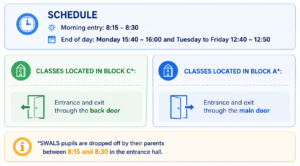
Below are the access points according to the location of the classes or section:
Primary
Arrival
In the morning, children are dropped off at their respective entrances.
When the bell rings, pupils are collected by their teacher in the playground.
Departure
_ If pupils are collected by their parents, they are accompanied to the exit by their teacher.
_ If they go to the CPE or are taken care of by daycare centers (Sunflower, La Luciole, Rockids,
Tiramisu, Butterfly, etc.), pupils will meet their teacher in the school playground.
_ Pupils enrolled in an extracurricular activity immediately after school will go to the gathering point and will be supervised by the extracurricular staff.
_ Pupils who take the bus will exit through gate 1 (BUS), which leads directly to the bus platform.
_ Pupils who are authorised to leave alone (after completing the “Authorisation to leave” form) and who have their card will leave through the main primary school gate. Primary school pupils are not allowed to leave the school building alone outside of school hours. In the event of early departure, which must be duly announced, and only in this case, the pupil must be picked up by their parents in the main hall. The security guard is responsible for checking all information relating to early departure authorisation.
It is essential to complete the “Authorisation to Leave” document that will be given to you at the beginning of the school year so that we are aware of your child’s daily departure arrangements. In the event of a one-off change, please notify the teacher by email at least 24 hours in advance. In the event of a permanent or long-term change, the “Authorisation to Leave” document must be completed again.
Secondary
Entrance
Access is via:
• The main entrance from 7:50
• The bus dock gate will be opened as soon as the buses arrive (approximately 8:00 to 8:20)
• The gate giving access to the Coque will be opened according to the schedule of physical education classes taking place there.
• Access via the gate between the Administration building and the assembly hall is reserved exclusively for Primary School pupils.
Depending on their timetable, S1 to S5 pupils may be allowed to arrive at school later if a teacher is absent at the start of the day (authorisation A).
Departure
The exit is via:
• The main exit.
• The bus gate will be opened at the bus departure time.
• Once a pupil has gained access to the school premises upon opening of the gate and before the start of classes (between 7:50 and 8:20), they may not leave the premises, regardless of the exit authorisation they have.
• The gate giving access to La Coque is closed according to the schedule of physical education classes taking place there.
Permission to leave:
• S1-S5 pupils, depending on their timetable, may be authorised to leave school early when a teacher is absent at the end of the day (authorisation B).
• S4 and S5 pupils may be authorised to leave school during the lunch break and the period before and/or after the lunch break, provided that the pupil has free periods during this time (authorisation C). The absence of a teacher cannot be considered a free period.
The right to leave during free periods:
• is reserved exclusively for S6 and S7 pupils, subject to parental authorisation.
• may be requested in very exceptional cases. The request must be submitted in writing in advance to the Management, which will then grant approval if deemed appropriate.
For authorisations A + B + C, a link to a form will be sent to pupils and parents on the first day of the school year.
We would also like to remind you that it is not possible to leave the school during the 5-minute break between lessons.
SCHOOL FEES
For families with more than one child at the European school, the school fees are reduced by 20% for the second child, and by 40 % as of the third child. These fees are applicable only to the newly enrolled category III children, following the school year 2013-2014. For pupils enrolled before, the previous reductions remain in force. It should be noted that the amount of the school fees is indexed by 2% each year.
Any change in family or professional circumstances must be communicated immediately by email to the following address: LIST-LUX-MDM-SCHOOLING@eursc.eu
PAYMENT OF SCHOOL FEES
The reference documents can be consulted on the European Schools website (http://www.eursc.eu) under ‘Enrolment and Fees’. The Board of Governors has set the fees for pupils who are not automatically eligible (category III) for the 2026-2027 school year as follows:
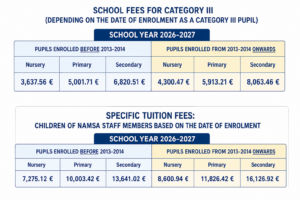
TERMS OF PAYMENT
Parents subject to school fees commit themselves to pay them in accordance with the following terms:
a) First enrolment of a child at the European School
In accordance with the decisions of the Board of Governors in April 2015 and in order to confirm the child’s enrolment, a deposit of 25%, payable before 5 July 2026, will be required.
b) Parents whose children already attend the European School
In accordance with the decision of the Board of Governors of April 2015, all Category III parents must pay a deposit of 25% by 30 June at the latest in order to maintain the existing enrolment for the following school year. This deposit is non-refundable (see Article 29 of the General Regulations of the European Schools, Ref: 2014-03-D-14-en-13).
A deposit invoice will be sent to them during the month of May.
c) Common provisions for all parents
The balance of 75% must be paid no later than 30 days after the date of the invoice, which will be issued in October.
However, provided that parents have introduced a corresponding written request to the School by 31st August at the latest, they will have the possibility to pay the remaining balance of 75 % in four instalments.
In this case, payments must be made no later than the following dates:
30th November 2026
31st December 2026
31st January 2027
28th February 2027.
The request for payment of school fees in instalments must be submitted using the form “Paiement des frais de scolarité par échelonnement” (Payment of school fees in instalments) available at 🔗 Enrolment – Schola Europaea Luxembourg I and will remain valid for the entire period of the pupil’s schooling.
IMPORTANT NOTES
No child will be admitted to class in September 2026 if the deposit has not been paid within the specified time frame.
Furthermore, if, by 1 September of the school year, all or part of one or more invoices have not been paid in full, the pupil concerned will be considered by the School as having been removed from the register and will no longer be admitted to the School for the school year. If necessary, the sum due will be recovered by legal action.
REDUCTIONS
In accordance with the guidelines of the Board of Governors some reduction may be granted on basis of a file with supporting documents. It is important to underline that these reductions are not automatic and that their obtention depends on the income and the composition of the family concerned (the evaluation method is based on the comparison of disposable income, less a basic amount, with the normally applicable fees).
The basic amount is fixed on a flat-rate basis each year for all European Schools and is adapted to each school individually by applying weightings fixed beforehand in line with changes in the cost of living.
To be valid, requests for reduction should be addressed to the Director of the School at the latest by 30th November of the current year. Supporting documents requested by the School to create a file for fees reduction must be returned at the latest by 30th January of the current year. These documents will be handled in the strictest confidence.
Requests for assistance may also be addressed to the Parents’ Association, which has its own social fund. To be eligible for assistance, you must be a member of the APEEE. [Appendix 4]
IMPORTANT NOTE
The Director may decide that, in certain situations—such as health or safety concerns, government directives, or exceptional events like epidemics, pandemics, natural disasters, or other unforeseen circumstances—online or remote classes do not automatically qualify for a reduction in the course fee. If you wish to request a fee reduction, whether your child attends in person or remotely, the request must follow the procedures outlined above.
CHANGE OF CATEGORY
When a pupil changes category due to a change in the parent’s professional status (for example, a change from category I to category III at the end of a temporary contract with the Commission):
• the Minerval must be calculated pro rata to the number of months concerned (one month being considered as one tenth of a school year):
• if the Minerval is to be paid from now on, from the beginning of the following month up to and including the month of July,
• if the Minerval is no longer payable, from September until the end of the previous month.
All 7th-year pupils (Categories I, II and III) must pay the Baccalaureate registration fee by 31 March of the relevant year.
For the 2027 Baccalaureate, the fee is 108.10 €.
It will be included in the October school invoice.
All pupils (Categories I, II and III) are subject to additional fees. These are payable by parents and included in the October invoice unless stated otherwise.
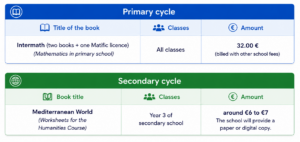
Intermath
• 2 mathematics books + Matific licence
• €32 (included in October invoice)
• Lost books will be invoiced separately. Replacement requests:
LUX-ACCOUNTING-SCHOOLFEES@eursc.eu
Photocopying costs
Photocopying for classroom use is invoiced centrally to avoid teachers collecting money. A fixed annual amount (based on equipment and supply costs) will be included in the October invoice.
Please note: According to the General Rules of the European Schools, parents commit to paying all school fees within the stated deadlines.
School outing fees for nursery and primary school pupils
Two payments per child:
• €100 for excursions and external activities (invoiced by the school). In accordance with the Memorandum on school activities and field trips, any applicable refund will be issued to parents, subject to the terms and conditions set out therein.
• €40 class fund (managed by class treasurers for small projects and activities)
Detailed information will be provided at the beginning of the school year.
The Mediterranean World
Humanities booklet approx. €6–7 (included in October invoice)
University registration file
If the school handles university applications:
• €132,60–€265,20 (depending on country/university)
For French and UK universities, applying through the school is recommended.
Parents must:
• Complete the form on the school website (“Procedures and Forms”)
• Pay the fee in advance
• No group payments accepted
Certification report of historical grades obtained
€150 per request
Request by email to the relevant cycle secretariat. Payment required in advance.
Catering services are provided by SODEXO.
The SODEXO service provider’s office is located at the back of the canteen and is open Monday to Friday from 8:00 to 11:30.
Tel: 26 68 39 45
Email: ecoleeuropeenne1.LU@sodexo.com
Website: 🔗 https://sodexoeducation.lu/
Less waste at School
The school promotes environmental awareness and waste prevention. The project aims to reduce waste and encourage responsible consumption at school.
Since the 2022/2023 school year, we recommend avoiding disposable plastics such as cling film, single-use packaging, and plastic water bottles.
Instead, pupils should use reusable lunch boxes (preferably stainless steel) and refillable water bottles. Simple snacks like sandwiches, fruit, vegetables, cereals, or homemade cakes can easily be packed without disposable packaging.
MEAL TIME
Nursery School
Pupils eat in their classrooms on Mondays only, between 12:30 and 13:30.
Meal times are organised according to the school timetable [🔗 Canteen].
Primary School
Meal times are organised according to the school timetable [🔗 Canteen]
For P5 pupils, the terms and conditions for secondary school pupils (secondary school self-service only) apply.
For secondary school pupils, teachers and administrative staff, there are various points of sale. Hot meals, sandwiches, snacks and drinks are available for purchase [🔗 Canteen].
🔗Registration via the service provider’s website is mandatory (including the “tartiniste” option).
Meals must be paid quarterly in advance. Fees depend on the number of days the catering service is used.
Meals not taken will only be reimbursed from two weeks of consecutive absences and for duly attested medical reasons.
Secondary Cycle and P5 – Meal Payment Information
• All meals, snacks, desserts, and drinks must be paid using electronic payment cards, which can be reloaded online.
• The card is valid for your child’s entire time at school.
For new pupils and P4 graduates:
• Please request a card from the provider by email before the school year starts.
• The card is free and will be given to your child by their main teacher.
For pupils arriving during the school year:
• Cards can be picked up at the SODEXO office at the back of the canteen.
Lost or damaged cards:
• Report immediately to the SODEXO office or by email.
• Replacement cards cost €15, and the balance from the old card will be transferred to the new one.
Compulsory school trips are an integral part of the European Schools curriculum. Participation is mandatory for all pupils concerned (S2, S5 and S6). The school is responsible for organising the trips and defining their educational content. Parents are responsible for the related costs (all compulsory trips exceed €100 per pupil).
For the avoidance of doubt, a trip is considered compulsory not only when it is explicitly designated as such in the curriculum, but also when it has been formally approved by the Director as part of the school’s educational programme. Participation in any such approved trip is mandatory for the pupils concerned.
Trips may include ski, sports, sea or “à la carte” secondary trips. All pupils at a given level participate, even if destinations differ.
The school expects all planned compulsory trips to take place during the 2026/2027 academic year. School management reserves the right to exclude a pupil for behavioural or safety reasons.
In addition to these compulsory school trips, numerous subject-related outings and trips (lasting a maximum of one school day) are organised throughout the year. Parents are invited to support the classes as accompaniers. The decision to ask parents to accompany day trips is made by the class teachers. Participation by pupils is also compulsory.
S2 and S6 pupils take part in a school trip that is part of the curriculum. The S2 and S6 trips will be organised in the spring.
S5 pupils take part in a school trip that is part of the biology curriculum. This trip, which normally lasts two days and one night, will be organised in the spring and involves several groups.
Parents will receive all additional information about the respective school trips in due course. In addition, information evenings for parents will be offered.
In addition to these compulsory school trips, numerous subject-related outings and trips may be organised during the year. Participation by pupils is also compulsory.
1. Mandatory Approvals
All trips and outings (including those outside school hours) require:
✔ Approval from school management
✔ Written parental authorisation
2. Travel Abroad (Minors Without Parent/Guardian)
Pupils must carry:
✔ A valid identity document
✔ A parental consent certificate
3. Administrative Fee
A chancery fee may apply for issuing official authorisation. This fee must be paid directly to the local authority by the parents.
4. School Form – 🔗Appendix 6
The form must:
✔ Be completed in full
✔ Be signed by hand by the parent/legal guardian
✔ Be submitted to the school office/teacher
✔ Include a copy of the valid identity document of the signing parent/legal guardian
All organisational regulations communicated by the school must be strictly respected.
Special Provisions
Luxembourg Residents – Required Documents
✔ Parental authorisation for outings/medical consent [🔗Appendix 5]
✔ Official authorisation issued by the municipality of residence
Signature Legalisation
The parent/legal guardian must appear in person to legalise their signature and provide:
• Departure and return dates
• Destination (country and location)
• Name of the accompanying adult
Further information: https://guichet.public.lu
Non-Residents – Required Documents
✔ Parental authorisation for travel/medical consent [🔗Appendix 5]
✔ Parental authorisation for non-resident travel [🔗Appendix 6]
By registering (*) their child for a school trip, the pupil’s parents
• understand and agree to the rules below about any possible refund for part of the trip cost.
(*) Registration here means the formal, written registration of the pupil for a school trip and not a simple expression of interest, for example following a “survey” organised by a teacher at the School.
Note: for compulsory trips, parents undertake to pay the price. In the event of non-participation not approved by the Management, parents will be required to pay the price of the trip.
However, if a medical certificate is provided and accepted by the cancellation insurance, only the excess will remain payable by the parents.
Please note that for trips with a small number of participants (fewer than 10 pupils), no cancellation insurance is taken out. In such cases, the provisions relating to reimbursement by the cancellation insurance do not apply.
The refund terms are as follows:
a) In the event of a pupil’s withdrawal for duly established reasons, the School will reimburse any expenses it has not already incurred in relation to the trip and any costs it has incurred but for which it can still obtain reimbursement. In this case, the refund will be made after deduction of any cancellation fees incurred by the School. In the event of withdrawal for medical reasons, a medical certificate must be submitted to the School. In all cases, the refund will only be made after the School has been able to establish the final statement of expenses relating to the trip.
It should be noted that the School does not always take out cancellation insurance. For school trips costing more than €100 per pupil, the School takes out insurance on behalf of the parents (included in the cost of the school trip), whereas for school outings or trips costing less than €100 per pupil, no cancellation insurance is taken out. The School will communicate whether or not insurance cover is provided. Any excess retained by the insurer when making a claim is payable by the parents.
b) In the event of a pupil’s exclusion before or during a trip, the School will not reimburse any travel-related expenses whatsoever. In addition, the pupil’s parents undertake to reimburse the School for any additional costs that may be necessary to ensure the child’s repatriation as soon as possible, as well as any costs relating to School staff who may be required to accompany the pupil (for all or part of the journey) during repatriation (taxi, plane, accommodation costs, etc.).
c) If a school trip generates a surplus of:
– ≥10% of the price invoiced to parents (for example, if the school trip costs €460 per pupil, any amount ≥ €46) or
– a total amount of €50 per pupil (e.g. if the school trip costs €700 per pupil, any amount ≥ €50), this amount shall be reimbursed to the pupils/parents.
If there’s only a small leftover amount, it goes into the “Kitty” (reserve). This money helps cover trips that cost more than planned and unexpected expenses, so the School doesn’t have to handle complicated refunds.
In the event of cancellation by the management
To ensure the health and safety of pupils and accompanying adults, the Director may cancel any planned trip or excursion, compulsory or optional, in the event of force majeure (e.g., epidemic, pandemic, natural disaster, third-party or governmental actions), unforeseen circumstances, or any situation affecting safety or the smooth running of the trip. This decision may be taken directly by the Director if he considers that safety or health conditions are not met and/or in accordance with the directives of the decision-making bodies of the European Schools and/or national government authorities.
In this case, and without the School being required to consult parents, the School will take all possible steps with the various service providers to try to reduce the financial impact of these cancellations, without being able to guarantee the outcome.
In accordance with the directives of the Board of Governors, the balance of the costs relating to the cancellation of the trip/excursion that remains due will not be covered by the School and will remain the responsibility of the parents. The final statement will be drawn up by the School and communicated to parents at a later date.
If a full or partial refund of the balance of the costs relating to the cancellation of the trip/excursion is obtained from the service providers, the refund to the parents will only take place after the final statement of costs relating to the trip/excursion has been drawn up by the School.
Air travel: flight delays or cancellations
In the event of flight cancellation or delay, and in accordance with European Regulation No. 261/2004 of 11 February 2004 establishing common rules on compensation and assistance to passengers in the event of denied boarding, cancellation or long delay of flights, the carrier is required to respect the rights of passengers provided for in this Regulation.
The names of the carriers will be provided by the teacher when organising the trip.
If you have any questions in this regard, please contact the airline(s) concerned directly.
• The “Comité des Activités Sociales (CAS)” of the European institutions provides both European Schools with an annual budget for financial assistance for parents of pupils at these Schools.
Please find more information on the 🔗 school’s website.
• The Parents’ Association of the European School Luxembourg I (APEEEL1) aims to support families who need financial assistance to cover expenses related to school trips, the purchase of an electronic device, and other educational costs. APEEEL1 has its own social fund, which is separate from the school’s social fund. 🔗 https://www.apeeel1.lu/social-fund-activities/
You will find all the information you need about extracurricular activities on the website:
🔗 https://periscolaire.apeeel1.lu/
🔗 Appendix 3 – Letter
🔗 Appendix 4 – Membership Form
Access to the online catalogue: 🔗LINK
The online catalogue “Oliver” can be consulted at the following address: 🔗 https://eel1.oliverasp.co.uk.
Each pupil has a personal account. This allows them to view the books they have borrowed, save reading lists, extend the loan period for a book, etc.
To log in, simply use your school email address (the same as for Office) and click on “Forgotten password” to generate a password and access the site. The catalogue can also be consulted without a login, in read-only mode.
Any lost or damaged books must be replaced by the families.
Contacts:
Librarian Ms Nadine Peiffer Tel.: 432082 383
Email: LIST-LUX-PRI-LIBRARIAN@eursc.eu
Opening hours:
Monday, Wednesday: 8:25 – 16:00
Tuesday, Thursday, Friday: 8:25 – 13:15
Access to the online catalogue: 🔗LINK
The online catalogue “Oliver” can be consulted at the following address: 🔗 https://eel1.oliverasp.co.uk.
Other resources:
Luxembourg National Library: Registration is strongly recommended for those aged 14 and over. It provides wide range of print and digital resources (e-books, journals, databases, etc.).
Library Sharepoint: 🔗 https://eursc.sharepoint.com/sites/Seclibrary
🔗LINK
Nursery school: Opening hours of the nursery school infirmary: Monday from 8.30 to 16:00, Tuesday from 8.30 to 13.15, Thursday from 8.30 to 13.15 and Friday from 8.30 to 13.15. If the nurse is absent, the assistants will accompany the pupils to the secondary school infirmary.
The primary school infirmary, located on the ground floor (block B of the primary building), is open every day as follows: Monday and Wednesday from 8:25 to 16:20 and Tuesday, Thursday and Friday from 8:25 to 13:15.
The secondary school infirmary, located on the ground floor of block C (room C-002) of the secondary building, is open every day from 8:30 to 16:30.
In the event of an accident, pupils are sent directly to the hospital on duty and parents are notified immediately by telephone.
In the event of a minor accident, parents are required to take their children to the hospital.
Within three days, parents must complete and return to the nurse the form available from the medical service and attached to this document Appendix AAA allowing the school to establish the accident report.
The school medical service deals with accidents and/or illnesses that occur at school and/or on the way to school. The medical service provides emergency treatment but does not provide follow-up care. Please note that injuries and illnesses that occur at home (during holidays, weekends, etc.) must be treated by parents or the family doctor.
If the school (the nurse and/or teacher) considers that a child is unfit to remain in class due to their state of health, the child must be collected by their parents or another authorised person. Only pupils who are of legal age are allowed to return home alone.
Parents are required to notify the school office of any change in telephone number and, if necessary, provide the contact details of a person to be contacted in the event of the parents’ absence.
Please do not send your children to school if they are ill! Any child who arrives at school ill must be picked up by their parents or guardian in order to prevent the spread of illness or epidemics.
The school, the CPE and the after-school care centre are separate institutions that do not share medical information and/or medication. Please provide the necessary information yourself.
The School cannot be held responsible for incidents that occur during activities organised by the CPE under its sole responsibility and can only possibly intervene if these incidents were to impact school life (if the situation were to continue during school hours).
One doctor works part time for the school. Medical tests are done for nursery, primary and secondary pupils generally every 2 years and in accordance with the recommendations of the Ministry of Health. Further information on the medical examination of children in nursery and primary school will be announced in due course.
If a child contracts an infectious disease, parents must immediately notify the School and respect the rules of school eviction as indicated on the medical certificates.
The School will only communicate internally upon request or recommendation from the Ministry of Health in the interest of the school population. In this case, communication(s) will be in two phases, if it is deemed necessary: a first general communication to the entire school population and a second more targeted communication to the parent delegates of the classes concerned. No information about the pupil or the circumstances of the infection will be communicated outside the medical and safety department of the school and the administrative staff directly concerned.
Finally, information received by parents (verbally or in writing) regarding a notifiable disease will be systematically communicated to the Ministry of Health. The aim is to ensure good collaboration with local authorities and to identify the next steps involving the school.
It should be noted that pupils can be exempted from School for a period of 2 days by their parents and without a medical certificate.
At the time of enrolment and before the start of EACH school year, parents are required to inform the Management of:
a) Any health problems their children may have that require immediate special care. In the interests of the child, this information will be communicated to the nurse and the teachers concerned.
b) Individualised Care Plan (PAI)
In the event of health problems requiring special monitoring and/or emergency intervention, a document called an “Individualised Care Plan” / personal emergency plan (PAI) is issued and signed by the family doctor/allergist. A copy of the PAI document and the necessary medication must also be given to the nurse at the school where the child is enrolled.
c) Any change in office and/or private telephone numbers, and, if applicable, the contact details of a person to contact in the event of the parents’ absence.
d) Any change in the child’s health during the year must also be reported by post and addressed exclusively to the school management.
e) Any medical or psychological issues requiring special measures during tests (S1-S3) or exams (S4-S6) (e.g. extra time) must be communicated exclusively to the Director, accompanied by a medical/psychological certificate or report. The same request must be submitted before 15 October in S5 for the S6-S7 orientation cycle and for the Baccalaureate.
The school has links with various social and psychological services of the luxembourgish Ministry of education. Parents whose children have learning or behaviour problems are advised to first contact the educational advisers or the principal class teacher for the secondary school and the deputy-director for the primary school.
The school has also three psychologists. Their job is primarily to provide support in academic, emotional and behavioural manners concerning pupils. They also participate in the proceedings of the Special Education Needs and provide support and information to teachers in relation to pupils with specific needs.
IMPORTANT: the psychologists are not there to do psychoeducational and/or diagnostic assessments. These assessments must be made outside the school.
Scheduling an appointment is required and must be done by email. Please, allow for a wait of 2-3 days for an answer to the email and 10 days to obtain an appointment because of the workload the service is facing.
Ms. Virginie BATAILLE
virginie.bataille@eursc.eu

Ms. Sabine FASS
sabine.fass@eursc.eu

Ms. Raquel Fernandez
raquel.fernandez@eursc.eu

For more details, please refer to our homework policy.
Report cards will be distributed on the following dates:
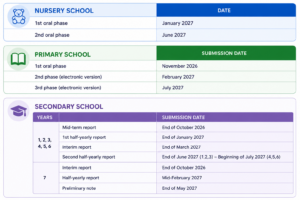
In general, compositions and assignments counting towards the B mark (years 4 to 7) can be consulted by parents by appointment with the teacher concerned. According to the general rules of European schools, the legal representatives of pupils are responsible for taking the B test in S4 and the official examinations in the first term of S5. In order to enable pupils in Years 5 and 6 to see the results of their end-of-year written examinations, teachers are requested to set aside a period of lessons during the last two weeks of the school year.
Parents of pupils in classes 5 and 6 may also consult the written examinations from Monday 29 June to Thursday 2 July 2027 between 10:00 and 12:00 in room B-002 in the presence of an educational advisor.
Article 6.4.10 of the European Baccalaureate Regulations states: “Candidates and/or, if they are minors, their legal representatives, are authorised to see and receive a copy of their original paper, the final mark awarded to the examination paper (average of the marks awarded by the first and second examiners and, where applicable, the mark awarded by the third examiner), the marks awarded by each of the examiners (mark of the first examiner, mark of the second examiner and, where applicable, mark of the third examiner), the examiners’ comments, the examination subject and the marking instructions.”
Consultation of examination papers after marks have been awarded:
The rules governing the European Baccalaureate stipulate that candidates have the right to consult their examination papers and the total marks awarded by each examiner.
The request must be sent by email to Mrs Farinelle [LUX-DIRECTOR@eursc.eu ], copying in
Mr Coll Marmol [ LUX-DEPUTY-DIRECTOR-SECONDARY-CYCLE@eursc.eu ] and the BAC coordinator [ sonia.raposo@eursc.eu ].
The Director will make all documents available within three working days of receiving the request.
Late requests to view exam papers will not be accepted. Regulations for the European Baccalaureate (Ref.: 2015-05-D-12-en-28.3)
Evenings will be organised for parents at different times of the year for the different cycles and classes. These will be announced in circulars in due course.
A lot of useful information is published on the school’s website (class timetables, book lists, holiday calendar, and much more). Some documents can only be viewed online. Announcements will also be made on the SMS-MySchool portal [🔗 https://sms.eursc.eu].
_ 43 20 82-1
_43 20 82-344
🔗IT/Distance learning help desk
These staff members can be met by appointment. Please contact them by e-mail or by telephone using the numbers indicated and inform them in advance of the topic you would like to discuss.
Teachers cannot be contacted by telephone. Parents may send messages to individual teachers via their children to arrange interviews or by email [ https://sms.eursc.eu under “Course Info” ]. The pupil’s diary is a means of communication between parents and teachers.
A list with the appointment reception times for each teacher (by appointment), along with their professional email addresses, is published on the school website during the 1st term of the school year.
Primary and Nursery School
Once an appointment has been made, parents will receive confirmation (by email) from the teacher specifying the location and time of the meeting. This confirmation must be presented to the security guard at the entrance to the building in order to access the meeting location.
Secondary School
When parents have a question, they are asked to follow the following communication policy:
• For absence or disciplinary problems: the education advisers for the year concerned;
• For problems related to learning or teaching the subject: the teacher;
• For problems relating to socialisation, integration into the group/class, etc.: the education advisor for the year in question. For problems relating to socialisation, integration into the group/class, etc.: the education advisor for the year in question, the main teacher or any other teacher;
• For questions relating to enrolment and choice of options: the cycle coordinators;
• For questions relating to school guidance: the guidance teacher in the language section concerned;
• For any questions concerning guidance, etc.: The guidance coordinator,
• For learning disabilities proven by a specialist report, dated less than two years ago: the support coordinator.
Parents may contact the secondary school management or the school management only if no solution to the problem can be found.
Nursery/Primary
If a pupil is unable to attend school for health reasons, parents must inform the class teacher and the primary school office before 8.30 .
[ 🔗 LIST-LUX-PRI-PUPIL-ABSENCES@eursc.eu ].
The child must provide a medical certificate to the class teacher upon their return for any absence of more than two days. After seven late arrivals or three unjustified absences, a reminder will be sent to the family.
Secondary
If a pupil is unable to attend school for health reasons, parents must inform the year’s educational advisor before 9:00 at the relevant email address:
🔗 S1: LIST-LUX-SEC-PUPIL-ABSENCES-S1@eursc.eu
🔗 S2: LIST-LUX-SEC-PUPIL-ABSENCES-S2@eursc.eu
🔗 S3: LIST-LUX-SEC-PUPIL-ABSENCES-S3@eursc.eu
🔗 S4: LIST-LUX-SEC-PUPIL-ABSENCES-S4@eursc.eu
🔗 S5: LIST-LUX-SEC-PUPIL-ABSENCES-S5@eursc.eu
🔗 S6: LIST-LUX-SEC-PUPIL-ABSENCES-S6@eursc.eu
🔗 S7: LIST-LUX-SEC-PUPIL-ABSENCES-S7@eursc.eu
To return to class after an absence of more than two days, a student must provide a written excuse and a medical certificate.
For absences of less than three days, where no medical certificate is required, or for absences that were not covered by a prior authorisation request, the student must submit a written explanation stating the reason for the absence. This may be sent by email or provided in writing, signed by a parent or legal guardian and handed in upon the student’s return to school.
Except in cases of duly certified illness, a pupil may only be exempted from the obligation to attend school with the authorisation of the Director. The request is to be send to :
lux-secretariat-secondary-cycle@eursc.eu
Except in cases of force majeure, this authorisation must be requested by the parent/s at least seven calendar days in advance using the form available at Appendix 7 also available on the school’s website under the heading “Forms”.
The request must be made in writing and supported by the necessary evidence. In exceptional cases, the Headteacher may authorise an absence for a maximum of two days.
Parents’ attention is particularly drawn to the fact that it is not possible to authorise pupils’ absences in the week preceding or following holiday periods, except in exceptional cases provided for in the General Regulations (Article 30). Transport/airline ticket issues are not considered exceptional cases. A special circular on the rules governing absences during the school day will be provided to parents of secondary school pupils at the beginning of the school year.
Parents can check teachers’ absences for the day on the school website under the heading “Teacher’s absences”:
Primary: https://www.euroschool.lu/luxschool/slideshowframes_primary_new.htm
Secondary: extranet.euroschool.lu//luxschool/slideshowframes_student_new.htm
A generic account is provided to all parents of pupils at the European School Luxembourg I with the pupil’s computer account. Parents are requested to contact the secondary school office for any information on this subject.
SMS-MySchool
🔗 https://sms.eursc.eu
SMS-MySchool is the common school management portal used by all European Schools. Parents, secondary pupils, teachers and administrative staff have personal access.
Main features
• Online timetable available from the beginning of the school year
• Real-time recording of absences (parents are notified; last 14 days visible)
• School life information (parent evenings, trips, events, etc.) with email notifications
• Course information (content, topics, objectives)
• Upcoming assignments, tests and exams (secondary)
• Overview of graded work
• Online publication of term reports
Important: SMS supports schoolwork but does not replace pupils’ own notes or all classroom assignments.
Parents must inform the administration immediately of any change of address, employer or contact details via:
LIST-LUX-MDM-SCHOOLING@eursc.eu
Login Rules
• Secondary pupils log in using their Office 365 account.
• Parents use their own registered email address.
• Primary pupils do not have access to the portal.
Daily requirements for pupils:
1. Check their school email (Office 365)
2. Log in to the SMS portal
3. Use only the school email address for communication (no private emails or social media)
Office 365 (from P3 onwards; not for Nursery, P1 & P2)
Office 365 includes:
• Mail & Calendar
• OneDrive (cloud storage)
• Word, Excel, PowerPoint
• OneNote
• Teams
The O365 email address is also used to log in to SMS-MySchool.
If a password is forgotten:
• A secondary email address must be registered in SMS
• Follow instructions on the ICT Helpdesk website
🔗https://www.euroschool.lu/site/ict-helpdesk-distance-learning/
Login details for both the school IT account and the O365 account are sent to parents at the beginning of September.
Distance Learning
The school has established distance learning policies (Appendix 8 _ Distance learning_ Sec & Distance learning_Mat_Pri).
Important:
• All pupils must have access to their O365 account.
• Secondary pupils are strongly recommended to have their own computer (BYOD).
Support and contact form:
🔗 http://www.euroschool.lu/site/secondary-helpdesk-distance-learning/
The school provides a Wi-Fi network for pupils called “Euroschool”, accessible across the entire site. Pupils may use their own devices within the BYOD project using school login details.
• S1–S3: No smartphone Wi-Fi access.
• From S4 onwards: Smartphone Wi-Fi allowed only in break rooms and outdoors.
• Classroom use (S4–S7): Only with teacher permission.
Wi-Fi access is granted automatically to pupils who:
• are at least 13 years old,
• are in S4 or above,
• have accepted the IT Charter at least once per school year on a school computer.
The IT Charter prohibits the use of social networks and the use of the school email address to create private accounts. Internet access is filtered; VPN connections are not allowed. Bandwidth is limited but sufficient for OneDrive synchronisation and video streaming. Non-essential services (private clouds, updates, gaming platforms, etc.) should be disabled.
Access to school IT resources is a privilege, not a right, and is strictly for educational purposes. The school may carry out checks. Violations may lead to disciplinary measures according to the General Regulations and Internal Rules. Parents, as legal representatives, are responsible for ensuring compliance. Parents may request that their child’s Wi-Fi access be blocked.
The school’s IT department does not configure private devices (except within the BYOD project). Pupils may contact the pupil committee for help.
🔗 LINK
Since 2020–2021 (from S5 onwards), pupils must have a laptop or tablet capable of running GeoGebra 6, according to increased technical requirements. Currently, this applies to all S5–S7 pupils.
Lockable charging lockers are available near the secondary cafeteria and canteen entrance. Pupils must use them responsibly.
Main objectives:
• Make learning more attractive and effective
• Improve homework management
• Offer differentiated activities
• Promote responsible use of digital technologies
• Raise awareness of internet risks
• Gradually introduce digital textbooks
• Optimise distance learning
• Improve typing skills (without replacing handwriting)
Practical aspects:
• Devices are used for educational purposes only.
• They complement, not replace, traditional materials.
• Usage in lessons depends on the teacher.
• The project includes digital literacy education (including workshops with external experts).
• A teacher working group evaluates and develops the project.
• Exchange with other European Schools is encouraged.
The school rules define all the rules of school life. They set out the rights and duties of each member of the educational community.
The school’s internal regulations are also available on the school’s website www.euroschool.lu.
The school would like to draw your attention to the following points:
Primary
Parents may accompany pupils to the Coque swimming pool.
To ensure the safety of pupils, it is necessary to clarify everyone’s responsibilities.
a) The swimming instructor is responsible for:
• The course taught and compliance with the EE Curriculum,
• The safety of the pupils, for which he is assisted by the head teacher.
b) The regular teacher is responsible for:
• Their pupils at all times,
• Assisting the swimming instructor in supervising his/her pupils,
• Remaining alone with the swimming instructor around the occupied pool.
c) The accompanying adult for groups of more than 14 pupils:
• Accompanies the group during travel (there and back),
• Supervises one of the two changing rooms,
• Joins and follows the lesson from the stands. He does not have access to the pools.
Secondary school
• First-year pupils travelling to the sports complex are accompanied by their physical education teacher on the outward and return journeys.
• Other classes meet their PE teacher at the sports complex, La Coque or Hall G. The teacher sets the meeting place with the pupils.
It is forbidden to take photos or videos anywhere on school premises, including the swimming pool and gyms (pupils, parents, school staff).
The European School of Luxembourg I strongly opposes the consumption of tobacco and alcohol and the use of drugs by pupils in general and, in particular, in the buildings and throughout the school grounds, as well as during school activities/excursions.
In the event of an incident that endangers the health and safety of pupils, the school reserves the right to communicate any detailed and necessary information to the competent authorities.
Furthermore, in the context of a judicial investigation, the school complies with the requirements of the competent authorities. The school will not interfere in the conduct of a judicial investigation and will therefore not communicate the progress of the investigation to those directly or indirectly concerned.
The school has a special campaign with specific measures, called “Just say, No!”, which can be consulted on the school’s website.
Tobacco
Smoking is strictly prohibited in all buildings and throughout the school grounds. The law of 11 August 2006 on anti-smoking expressly prohibits smoking inside educational establishments of all types and on their premises. Violations of this provision are punishable by a fine of €25 to €250.
Drugs, alcohol
Any pupil found in possession of drugs or alcohol on school grounds or during a school activity/excursion may be summoned before a disciplinary committee.
As part of the “Schola Sana” project, the school has introduced procedures to be followed in the event of pupils being at risk:
1. if a child is known or suspected to be at risk
2. in the event of possession, sale or consumption of alcohol or drugs
The aim is to ensure that reported cases of children at risk are followed up. These procedures are put in place by the school, but any member of the school community can initiate one of them if they deem it necessary. Details of how these procedures are applied can be found on the school’s website under ” 🔗 Pastoral care“:
The school’s psychologists, in collaboration with teachers and the relevant authorities, also organise awareness-raising and prevention workshops in classrooms throughout the year.
Secondary school pupils are not permitted to use neither the primary school nor the nursery outdoor areas. Football may only be played in the designated secondary playground.
Any games or activities that may endanger the safety of pupils are prohibited.
The bringing of dangerous objects onto the school campus (including knives, firearms, airsoft guns, pepper spray, fireworks, or any object that may be used to threaten or cause injury) is strictly forbidden.
Pupils are required to hand in any lost property either to their teacher, one of the educational advisors or the caretaker. Lost property is placed in a box and can be collected from room B-001 (for small items of value) or room C-007 (for clothing and larger items). If the lost item is not claimed by the end of the school year, it will be donated to a charity. Taking possession of a lost item without the intention of handing it over to the above-mentioned persons may be considered theft.
In nursery and primary school, the non-educational use of mobile phones and any other electronic equipment (smart watches, etc.) is prohibited for children during the school day on the entire school grounds.
A full description of the rules governing the use of mobile phones and connected devices is detailed in the 🔗 Appendix 12.
A working group, made up of all stakeholders in our school community, met to establish a new policy on the use of mobile phones in secondary school. This new policy was approved by the Education Council and published at the start of the 2024-2025 school year.
A full description of the rules governing the use of mobile phones and headphones is available in the secondary school’s🔗 internal regulations.
Our school has a zero-tolerance policy towards any type of racist or discriminatory behaviour. This applies to language and gestures as well as the use of offensive symbols. Given the fundamental values on which our school was founded and to which it remains committed, the use of provocative political symbols or gestures associated with totalitarian regimes, for example, whether past or present, left-wing or right-wing, must also be considered inappropriate in our school environment.
All monetary transactions between pupils such as soliciting or selling goods, charity collections etc. are not allowed on the school grounds during the school day, unless specifically pre-authorised by the management.
Coverage
Pupils are insured against bodily injury occurring during the school day, authorised school activities and trips, and during the normal journey between home and school. In the event of an accident, parents must contact the nurse of the relevant cycle to complete an accident report (see also 🔗 Appendix AAA ).
The school is insured for accidents with the “Association d’Assurances Accidents” (AAA). Please note that it is essential to obtain prior authorisation from the AAA before undertaking any treatment abroad following a school accident.
The insurance does not cover incidents arising from unauthorised activities or when pupils leave the school premises without permission.
Damage caused by the pupil
Pupils are covered for bodily injury caused to third parties during the period in which they are under the direct or indirect responsibility of the School. However, they are not insured if the damage caused to the third-party results from the use of a motor vehicle belonging to or driven by the pupil.
Any costs resulting from vandalism or material damage, including but not limited to breakages, damage to the School’s buildings, facilities, fittings, furniture, library books or other School property, caused by a pupil, shall be borne by the pupil’s parents or legal guardians. A procedure will be put in place whereby parents or legal guardians will receive an invoice covering the cost of repair or replacement.
Damage to the pupil’s property
Pupils are not insured for damage to their personal property and clothing, particularly in the event of theft, including items stored in lockers.
The School will not respond to any claims from pupils or parents regarding such incidents (theft of phones, money, SODEXO cards, etc. and/or damage to pupils’ equipment and personal belongings) and, as a result, these will not be dealt with internally in any way (interviews, inspections, CCTV footage checks). However, if an offence is committed, the School reserves the right to take any necessary action.
Pupils’ lockers should be used to keep items locked away, but they are neither insured nor monitored. In general, pupils should not bring items to school that are not useful for their work. With regard to theft, the school reminds parents that pupils are advised not to leave money or valuables in changing rooms and lockers.
Each year, the school publishes a list of textbooks that all pupils are required to purchase.
Nursery/Primary – Nursery and Primary: List of Books – Schola Europaea Luxembourg I
Secondary – List of Books – Schola Europaea Luxembourg I
The list will be available on the school website from 20 June of the previous school year. In addition, for certain subjects, books published by the European Schools are compulsory and invoiced to parents.
The “Eurobio 6-7” textbooks for Biology 4 will be published by the Publications Office (OPOCE) on their “EU Bookshop” 🔗 website.
Anyone interested can download the PDF file.
All pupils in classes S1-S7 must have a neatly kept diary in which lessons and homework are recorded. The use of the school diary distributed free of charge to pupils in S1-S3 is compulsory.
Calculators and electronic devices
You can find the school’s recommendation regarding the minimum specifications required for laptops used for educational purposes at school in 🔗Secondary: Calculators and computers – Schola Europaea Luxembourg I.
Advisers from various European Union countries visit the school and are available to meet with parents and pupils. Documentation concerning university studies is available to pupils in the secondary school library.
A team of teachers is available to listen to and advise pupils who are facing personal problems or difficult situations at school. These pupils can take advantage of the guidance service during their free periods. A list of teachers who are members of the guidance group will be posted in each classroom at the beginning of the year. All discussions will remain strictly confidential.
This is a summary guide and should not be considered as a set of rules. In case of doubt, the school will always apply the rules of the European Schools.
All choices must be made during the previous year before the end of January.
🔗 Nursery and Primary : Educational Programme
* The choice of language section is final and cannot be changed during your child’s schooling.
* The choice of Language II (LII) is also final, unless the Class Council recommends a change.
* For children in the second year of nursery school, parents will receive a form in May to choose Language II (LII).
* In primary school, any requests to change Language II (L2), Ethics, Religion or an ONL course (Swedish, Finnish or Irish) must be submitted to the school office by **31 January**.
* Once a course has been chosen, it must be followed for the entire school year. Changes can only take effect at the beginning of the following school year.
🔗 Secondary : Choice of subjects
Change of subjects studied
The procedure and deadline for requesting a change of subject depend on the year level and the subject. Please consult the web page dedicated to options and choices.
Please contact the coordinator for the relevant year if you have any questions about this.
In order to succeed in the higher years of the secondary school, a high standard in Language 2 (the “working language”) must be achieved. It is used as a teaching language from year 3 in Human Sciences (later History and Geography) and ethics/religion, and from year 4 in Economics.
Some information can be found on the general website of the European Schools: www.eursc.eu or directly on the website of the European School Luxembourg I: http://www.euroschool.lu
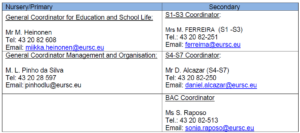
Specific questions can be addressed to:
🔗 Nursery and Primary : Educational support
🔗 Secondary : Educational support
Support coordinators (“Supco” and “Cogesu”)
Nursery and primary school
Mrs Sylvie MIRAGLIESE
Ms Annalisa DESTEFANIS
Ms Adriana PASTRANA
Secondary school
– Intensive support:
Ms. Frédérique DUCHESNE
Ms. Paola GIANNETTI
Mr. José A. PALOMO LOPEZ
– General and moderate support:
Ms Maria SALINAS
The reference documents (2012-05-D-14-en-10 and 2012-05-D-15-en-14) can be consulted on the European Schools website:
🔗 Educational Support and Inclusive Education | EURSC
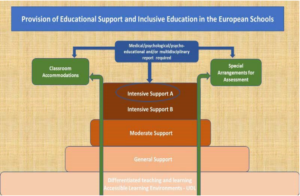
Educational support in the European schools is divided into two types of support: reasonable accommodations (in class and/or the tests and exams) and supports programs, namely General, Moderate and Intensive Support (A and B).
In class
Depending on their needs, pupils may require different accommodations.
European Schools encourage the use of assistive/compensatory technologies (devices, applications and software) and other accommodations for pupils with disabilities who may need them in order to access education on an equal basis with others.
An accommodation is a modification to the way a pupil is expected to learn or participate in class. Accommodations include special teaching and learning strategies, equipment or other supports that remove, or at least mitigate, the impact of a pupil’s special educational needs.
Universal and special arrangements in assessment situations
Universal provisions: these are provisions made available to all pupils in assessment activities. They may include booklets containing formulas in science subjects, simplified language in assignments and examinations, electronic versions of tests, adaptations to make assignments accessible, or the use of other provisions to be put in place.
These provisions are listed and made available to pupils during examinations, tests and other forms of assessment to enable pupils to realise their potential in the fairest way possible.
Special provisions: If the assessment conditions, including during pre-baccalaureate and baccalaureate exams, present a risk of disadvantaging the pupil’s performance – particularly if they have special educational needs – by preventing them from demonstrating the level at which they have acquired the required skills, special arrangements may be requested and authorised for written and oral exams.
Special arrangements are authorised when they are clearly related to the pupil’s specific needs and/or diagnosed disabilities and justified by a medical/psychological/psycho-educational and/or multidisciplinary report.
Assessment and promotion principles
The requirements and provisions of Chapter IX of the General Regulations apply to pupils who receive educational support but follow the full school programme in all its requirements. The class council then decides on promotion. The pupil is promoted.
Any pupil benefiting from a school programme and/or subjects adapted to their needs cannot be promoted in the usual way but may progress with their class group provided that this is in the interests of their social and academic development. The class council then decides on progression. The pupil is not promoted at the end of the year and does not receive a report card but receives a certificate. The year is not passed. Progression can continue until the first semester of S5 at the latest.
Any pupil who meets all the promotion criteria can resume normal schooling. To rejoin the standard school programme, they must therefore demonstrate achievements comparable to those of any other pupil.
Pupils in S5 must follow the full curriculum and fulfil the same criteria as all pupils in order to be promoted to S6. If a pupil’s curriculum is adapted in S6, it is not possible to resume the standard curriculum either during S6 or between S6 and S7. Any pupil entering for the European Baccalaureate must have completed the full curriculum.
European Schools issue a special report card that describes the subjects studied and the pupil’s level of achievement.
For more details about secondary school, please follow the link: https://www.euroschool.lu/site/fr/secondaire-soutien-educatif/
🔗 Secondary : European Baccalaureate – Schola Europaea Luxembourg I
European Schools believe that all pupils should have the opportunity to demonstrate their abilities under the fairest possible assessment conditions. Where these assessment conditions are likely to disadvantage a candidate – particularly if they have special educational needs – by preventing them from demonstrating their level of proficiency, special arrangements may be requested and authorised
for written and/or oral examinations. These arrangements are not intended to compensate for any lack of knowledge or skills. (see document 2012-05-D-15-en-14). Requests for special arrangements for the Baccalaureate cycle (S6 and S7) must be made before 15 October in the 5th year.
If a pupil at the school wishes to invite a friend from outside the school, a written request from their parents is required in advance. In principle, authorisation can only be granted for a maximum of one day and the teachers concerned must give their consent. The visitor must be of the same age as the pupils in the class. Authorised visitors must report to the head teacher for secondary school pupils and to the school office for primary school pupils in order to obtain written authorisation.
Provided that the visiting pupil has obtained this written authorisation, they will be covered by the school’s insurance during their visit.
In primary school, only former pupils are authorised to visit their former class.
For your safety and that of all users of the school premises, the perimeter of the site, the entrances and certain gathering places in the buildings of the European School Luxembourg I are under video surveillance.
The school site is monitored by a security service provided by an external company. This service is responsible for controlling access to the site for all users: pupils, parents, teaching and administrative staff, and other service providers.
All visits to the site must be requested and approved in advance. Proof of this confirmation must be presented to security guards in order to access the site. It is forbidden to remain on school premises (playground, circulation in buildings).
All users of the site (with the exception of nursery and primary school pupils) must wear and present their badge.
The school reserves the right to change its alert level at any time and to adapt security measures and procedures accordingly.
In the area of safety and hygiene, and in the event of an incident, the school complies with the requirements of the competent authorities. Any related information will be communicated with their consent.
The European School (the data controller) undertakes to respect your privacy and to comply with the requirements of the applicable national legislation transposing Directive (EU) 2016/679 of the European Parliament and of the Council of 27 April 2016 on the protection of natural persons with regard to the processing of personal data and on the free movement of such data, more commonly known as the General Data Protection Regulation (GDPR).
“Personal data” means any information relating to an identified or identifiable natural person. In the School, the persons concerned are the pupils and their parents/legal representatives. Consequently, your personal data will be processed solely for the purposes of administering and supporting your child(ren). It will be kept for as long as necessary and at least for the duration of your child(ren)’s schooling at the European School. It will be treated as strictly confidential and will not be disclosed to third parties, except where necessary for technical reasons relating to the operation of the European Schools or for legal obligations.
To facilitate the management of activities, the European School also enters into contracts with third parties. These third parties are required to respect the confidentiality of the data entrusted to them and to use it only for the purpose of fulfilling their commitments to the School. In this context, data processing agreements and arrangements are drawn up between the School and these third parties.
With regard to the processing of your personal data, or that of your child(ren), you have a right to information and a right of access to such data. You also have the right to have your data deleted, and you also have the right to object to its processing.
When the School processes personal data with your consent, this consent may be withdrawn at any time. Withdrawal of consent does not affect the lawfulness of processing based on consent before its withdrawal.
To facilitate the exercise of your rights, you can contact our Data Protection Officer by email: LUX-DPO-CORRESPONDENT@eursc.eu
For more details about our data protection policy, please consult our 🔗 “Privacy Statement” on the website of the European School of Luxembourg I.
In order to comply with Article (5) of the GDPR, the European School of Luxembourg I wishes to keep its database up to date.
To this end, parents/guardians are requested to inform the School administration by email as soon as possible of any changes to:
• Address;
• Employer;
• Email address;
• Private and/or work/office telephone number;
• Identity;
• Family status
• Pupil departure [ 🔗 Appendix 11]
to the following address: LIST-LUX-MDM-SCHOOLING@eursc.eu
In the event of a change of employer, administrative status or contract expiry date, please also attach a new certificate issued by your institution’s personnel department so that you can be placed in the correct financial category.
In the event of a change in family situation (separation, divorce), please provide supporting documentation establishing who has parental authority over the child.
Any supporting documents provided must be included in your child’s file. These documents must be returned to the School as soon as possible by the child’s legal representative(s). The undersigned certifies that the information provided is true and accurate and undertakes to notify the School of any changes.
We thank you in advance for your cooperation.
Our school takes photographs and makes video recordings of our pupils when they participate in a wide range of school activities (e.g. shows, school trips, etc.).
Authorisations relating to your child(ren)’s image rights must be entered by parents/legal guardians in the MySchool (SMS) system.
We would like to point out that, unless you indicate your choice in SMS (consent and/or refusal), as parents/legal guardians, you will not be able to access your child(ren)’s SMS profile(s) or the information contained therein.
In order to respect the privacy of your child(ren) and to comply with data protection legislation (the General Data Protection Regulation and applicable national legislation), we are legally obliged to obtain your prior consent before taking photographs and making video recordings of your child(ren) during the school year.
This must be done by you. To assist you in this process, you will find a description of each option below (see point 4.c).
If you have any questions and/or require further information, please contact our Data Protection Officer (DPO) by email at: LUX-DPO-CORRESPONDENT@eursc.eu
Image rights: definition
Any individual has the right to control his image, i.e. that allow to identify him, whatever the medium of format used (photo, film, drawing, painting, sculpture, comics, video game, figurine, etc.).
To invoke that right, the main criteria is for a person to be recognizable, either by himself or his relatives.
The image of the body parts may, in some cases, be protected.
Sometimes the features of a person can be identifiable from the context, such as a pictures’ caption.
Consent
When a person is identifiable, it is necessary to obtain their prior consent for:
Capturing their image: Before taking a photograph, their consent must be obtained.
Publish their image: The fact that a person agrees to be photographed does not automatically imply their consent to the publication, distribution or use of their image.
N.B.: With regard to minors, the consent of their legal representatives must be sought, even if the minor is deemed to be “capable of discernment”; the written and signed authorisation of the child’s legal representatives is required for the distribution or publication of an image, even in a school magazine.
How does the school seek parental consent?
Our school takes photographs and makes video recordings of our pupils when they participate in a wide range of school activities (e.g. shows, school trips, newsletters/gazettes, yearbooks).
In order to respect the privacy of your child or children and to comply with data protection legislation (the General Data Protection Regulation and applicable national legislation), we are legally obliged to obtain your prior consent before taking photographs and making video recordings of your child or children during the school year.
Valid for the current cycle, parents/legal guardians can now complete their responses to the consent requests online, on the SMS application.
How do I access the SMS Web parent portal?
The school your child(ren) attends will send you an email with your login and password. With these credentials, you can access the application from the following link: https://sms.eursc.eu/
When you access the SMS application (Parent Web), you must provide consent for your children or you will be denied access to the portal.
If you are defined as the child’s guardian, a “Privacy Statement ” will be displayed. You are asked to read this document and confirm that you have understood it.
This must be done for each child in the family.
Until all consents have been entered, you will be denied access to the portal.
What types of consent are there? [🔗 Appendix 10]
Yearbook
I authorise the school to take photographs of my child and publish them in the Yearbook for communication purposes.
Newsletter/Gazette/Magazine
I authorise the school to take photos of my child and publish them in a local school newsletter/gazette/magazine for communication purposes and to share the educational activities carried out by the pupils.
Website
I authorise the school to take photographs and make video recordings of my child during school activities and trips, celebrations and other school events and to publish them on the school’s website for communication and publicity purposes related to the school.
Communication with parents/class activities
I authorise the school to take photographs and make video recordings of my child during school activities and trips, celebrations and other school events and to share them with the parents of the class electronically (SharePoint or by email with a link to the parents concerned, with an expiry date) for communication purposes.
Communication to parents and teachers/joint activities
I authorise the school to take photos of my child during activities involving several classes or language sections (e.g. end-of-year shows, Christmas shows, school activities and trips) and to share them with parents and teachers at the school electronically (SharePoint or by email with a link to the parents/teachers, with an expiry date) for communication purposes.
Name association
If I accept one or more of the above options, I also authorise the school to associate my child’s name with the published photo (for example, to congratulate a child who has won a competition or prize) for communication purposes.
The consent form available on SMS authorises the School to:
_ Take photos as part of “school activities”: a general term allowing teachers who wish to do so to photograph pupils in class and not only during school trips, shows and/or other school events;
_ Share photos/videos: via tools authorised by the School such as Sharepoint, OneDrive, etc. … Prohibition of publication on social networks (WhatsApp, Facebook, Twitter, Instagram, etc.);
_ Images must be kept for a period of one (1) year. All photos from the past school year must be deleted by 31 December at the latest.
_ Consent given will be valid for the cycle (Nursery, Primary or Secondary). It may be modified or withdrawn at any time by sending an email to the School’s DPO.
_ The School cannot respond to requests for exceptions (e.g. sending an email to a teacher to exceptionally authorise the taking of pictures of your child during a specific event when the choice indicated in the SMS is “Rejected”). Only changes to the SMS form, and at your request, will be processed.
Who can give consent?
The persons who are defined as responsible for the child.
_ If both parents are defined as responsible, the first person to access the portal must give consent. An email is automatically sent to the responsible persons to notify them that consent has been given.
_ In the event of divorce/separation/joint custody, the first person to access the portal must give consent. An email is automatically sent to the second person responsible to notify them that consent has been given.
When should consent be given?
_ When the child is enrolled in school;
_ When the child changes cycle:
• Nursery to Primary,
• Primary to Secondary.
_ When the child changes schools.
How to change consent?
For any change of choice, you must contact the school’s DPO to submit your request via email: LUX-DPO-CORRRESPONDENT@eursc.eu
SMS: Obtaining new access codes
For any requests for new passwords and SMS access codes, please send your request via email to: LIST-LUX-ICT@eursc.eu
VISITORS GUIDELINES
The instructions mentioned in the document ” 🔗 Visitor Guidelines” document must also be followed by parents and all visitors when visiting or being present on the premises.
The School has not prohibited parents from taking photos during school events (shows, concerts, plays, etc.). This seemed a little unreasonable, as most parents take these kinds of photos to immortalise the event and have no intention of publishing them or posting them online.
Taking photos by parents during school activities is considered a “domestic activity” within the meaning of the GDPR, i.e. the processing of personal data by a natural person in the course of a purely personal or domestic activity, and therefore unrelated to any professional or commercial activity.
Recital 18 of the GDPR specifies in this regard that “Personal or domestic activities could include […] the use of social networks and online activities that take place in the context of these activities […] In other words, a parent could post a photo taken during a show on their Facebook account, provided that it is “private”, showing their child alongside other classmates. The parents of the other children, who may be uncomfortable with such a post, can ask the parent concerned to remove it.
The School cannot intervene in cases of difficulties relating to the sharing of photos taken by parents during school activities, as it is not the “data controller”.
USEFUL DOCUMENTS
_ The General Regulations of the European Schools (Ref.: 2014-03-D-14-en-15) are available in all official languages of the European Union and can be found on the European Schools website www.eursc.eu under Legal basis of the European Schools.
_ For requests for special measures for pupils with specific needs, it is strongly recommended that you consult the following documents available on the official website of the European Schools
https://www.eursc.eu/en/European-Schools/studies/educational-support
_ Policy on educational support in European Schools (Ref. 2012-05-D-14-en-10)
_ Educational support provision in European Schools (Ref. 2012-05-D-15-en-14)
The instructions mentioned in the attached “🔗 Visitor Guidelines” document must also be followed by parents and all visitors when visiting or being present on the premises.
During school trips, it is common for parents/legal guardians to accompany classes to help supervise the pupils. Although this is also a school activity, accompanying adults are NOT PERMITTED to take photos of pupils.
In accordance with the legislation in force, in line with Article 376-1 of the Luxembourg Civil Code, a parent who does not/no longer exercises parental authority retains the right to information on unusual aspects of their child’s academic life. This includes matters such as major changes in schooling, guidance or enrolment in a private institution.
Our approach is based on striking a balance between respecting these rights and protecting the best interests of the child. The school’s management and teaching staff are obliged to provide this information when requested by a parent who does not/no longer has parental authority. However, the decision to share specific details will depend on the nature of the information and its impact on the child’s academic life. Where appropriate, the headteacher will decide what information to share.
We remain committed to maintaining open communication and protecting the well-being of all pupils, while respecting the legitimate rights of parents.
In view of the above, access to SMS, as a purely technical and electronic means of communication, will be suspended for parents who do not exercise or no longer exercise parental authority. However, requests from parents to obtain information relating to their children will be considered on a case-by-case basis and the requested information may, where appropriate, be disclosed in accordance with the above-mentioned elements and procedure.